How to Keep Sweat Out of Your Eyes

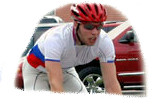
sweaty cyclist

It’s summer. The days are hot. And you sweat. The sweat drips into your eyes. It stings your eyes and smears on your glasses, impairing your vision.

Standard helmet pads just aren’t enough to soak up all the sweat. And you can’t stop sweating. But you can keep the sweat out of your eyes!

Here are eight different ideas I have tried out to keep my sweat at bay:


cotton bandana

1. Cotton Bandana

I wore those good old fashioned cotton bandanas (a.k.a handkerchief, do-rag, etc.) when I was a kid because I thought they were cool. Being cotton, I never wear them while riding, although I see some people who do.

The bandana soaks up sweat, but the cotton doesn’t do a good job of wicking the sweat away from your skin so it can evaporate. It is also a bit too thick, making it get very warm, and that thickness might interfere with your helmet’s fit.

Pros: Cheap; easy to find.

Cons: Bulky; warm; cotton is not a performance fabric.


coolmax do rag

2. Wicking Do-rag

A wicking do-rag is just like the old-fashioned bandana, but it’s made with a wicking material such as Coolmax so it actually works for cyclists. It is a lot like a skull cap, just with extra material hanging out the back.

It can still be a bit too bulky, although the extra surface area allows it to absorb more sweat and spread it out for easier evaporation.

Pros: Wicking material; more surface area for sweat evaporation.

Cons: Could be too much material.


coolmax headband

3. Coolmax Headband

I used to wear a terry cloth headband while playing basketball, to keep the sweat out of my eyes. I always liked it, so I started wearing mesh headbands while cycling. They work well and are thin enough to fit under my helmet (unlike terry cloth headbands.)

They are very lightweight and don’t take up much space, and they cost around $3. The Coolmax material, while there isn’t much there, will still soak up your sweat before it hits your eyes.

Just be sure to get the ones that tie in the back though. Ones that just slide onto your head will usually get pushed out of place when you put your helmet on.

Problem is, on very hot days, eventually the headband does get saturated with sweat faster than it can evaporate, so some sweat might still drip down.

Pros: Cheap; lightweight; no ventilation issues; Coolmax fabric is great; easily fits under helmet.

Cons: Eventually it will get saturated with sweat, rendering it useless.


coolmax skull cap

4. Skull cap

The skull cap is a cross between the old cotton bandanna and the Coolmax mesh headbands for cycling. Most of these thin caps are made of a Coolmax-type mesh material that is great for wicking sweat away.

Having more material than the headband, it takes much longer for it to get saturated. Your sweat soaks upward toward the top of the cap while the bottom end on your forehead soaks up new sweat.

Problem is, covering your entire head can restrict airflow to your scalp. That’s not great on super hot days. You also have to find a skull cap with the right fit. Some come down over the tops of your ears, which I don’t like (that’s a bit too warm for me.) Although it keeps the sun off your ears, so that’s a good thing.

However, it all depends on the particular cap. Brands will vary – for example, Headsweats and SweatVac caps are quite different.

Pros: Great sweat absorption.

Cons: Can’t feel air on your scalp; can be too warm.


halo headband

5. Halo Headband

The Halo is like a regular headband with something extra – it has an inner channel that redirects sweat away from your eyes.

It is comfortable because it is still fairly soft, small, and thin, but you don’t have to worry about it getting too saturated with sweat. That’s because instead of just absorbing sweat, Halo’s sweat channel redirects sweat from your forehead to the sides of your head, so it doesn’t end up in your eyes.

Pros: Comfortable; redirects sweat away from eyes.

Cons: More expensive.


sweat gutr

6. Sweat Gutr

The Sweat Gutr is interesting – it’s a plastic headband. It doesn’t absorb sweat; rather, it acts as a “gutter” to collect sweat and channel it to the sides of your head. That way, the sweat runs down the sides of your head instead of into your eyes.

The concept works, but you might have to play with the fitting system a little bit to make sure it fits comfortably. It’s very low-profile and will sit just about your eyebrows, so it’s not actually under your helmet.

Pros: Cool design; concept works.

Cons: Expensive; not exactly soft.


vaseline

7. Vaseline

If you hate the idea of getting a cap or headband, try this – you can wipe a little streak of Vaseline across your forehead, right about your eyebrows. It will be like a unibrow.

When done correctly, your sweat runs along that and down the side of your face. It is a lot like a single-use Sweat Gutr.

Just don’t take your glove and wipe off your forehead. There goes your headband!

Pros: Cheap; easy to find; convenience of a “single use” product.

Cons: Wipes off easily; can be messy.


towel

8. Towel

As seen in the very first picture, you could wrap a towel around your neck and use that to wipe sweat off your face. This method works, but it’s really only feasible while riding your trainer. (You don’t want to drop the towel into a spinning front wheel…)

Pros: Lots of absorbency; you probably own a towel already.

Cons: Doesn’t work while riding outside; dangerous.


My final verdict is…

In the end, I’m a big fan of the SweatVac Ventilator cap. It soaks up a lot of sweat but doesn’t make me overheat, so if I had to choose just one option, that would be it.

Want something a little different? Opt for the Halo or Sweat Gutr. They both work, but your choice depends on personal preference.

But no matter what your favorite product is, I think we can all agree that sweat dripping into our eyes sucks!

Tip: Whatever you get, make sure the edge of the headband, cap, etc. is pulled down almost to your eyebrows. That way it collects all your forehead sweat.

Photo credit: alex_lee2001

How to Determine Your Sweat Rate

Here’s the basic formula to determine your sweat rate:

Step 1: Weigh yourself before you ride. For example, let’s say you weigh 155 pounds before you start exercising. (Just like I do, if I’m at my race weight…)

Step 2: Exercise for an hour in the weather conditions and at the same intensity you expect to face in an upcoming race or long ride.

Step 3: After your workout, remove your dripping wet shoes, shorts, jersey, etc. Dry yourself off and weigh yourself again. Let’s say you weigh 151 pounds after your workout.

Step 4: To calculate your sweat rate per hour of exercise, subtract your ending exercise weight of 151 pounds from your beginning weight of 155 pounds. The difference of 4 pounds represents your fluid loss during exercise.

Since you should drink 16 ounces of fluid for every pound of fluid you sweat out during exercise, multiply the number of pounds lost by 16. In this example, you should drink 64 ounces of fluid to counteract the symptoms of dehydration and return your body weight to normal.

Step 5: If you drank any fluid during your 60 minutes of exercise, you’ll need to add that number to the total amount of fluid lost during exercise that you calculated in Step 4.

There you go. Those five simple steps will tell you how much fluid you need to consume. But remember, you can’t truly reproduce a race in a training ride. And weather conditions are always uncertain.

Once you know your personal sweat rate per hour, you can take fluid breaks so that every 15 minutes you consume 10 to 12 ounces of fluid.

By the end of your 60-minute ride, you won’t be so dehydrated, your performance won’t slow as dramatically, your body temperature won’t be as high, and you won’t have to drink as much fluid the rest of the day.

Facebook