
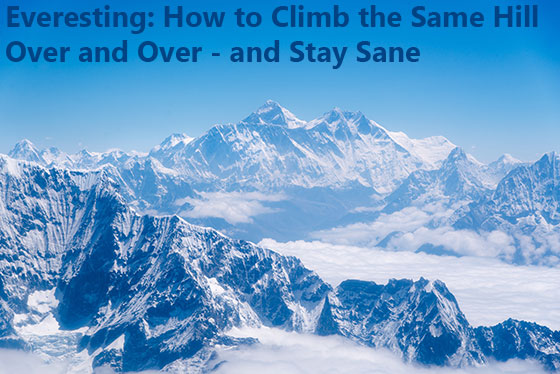
“Everesting.” You’ve probably seen it on Instagram, on Strava, or even in the news lately. Want to get in on the action? Here’s how.
What is Everesting?
Everesting is an endurance challenge that involves climbing a single hill enough times to equal the height of Mount Everest (8,848 m or 29,029 ft). Much like climbing the mountain itself, it’s an enormous physical and mental undertaking. Fortunately, there’s no travel required, it’s far less dangerous, and it’s more accessible to the average person.
It’s an extreme version of hill repeats!
The idea is not new. According to Everesting.cc, there have been over 11,000 documented Everestings already. Those include bike rides, runs, and even virtual bike rides on Zwift.
The popularity of Everesting is surging though. There were only about 5,000 instances prior to the pandemic and now we’re past 11,000! A big chunk of those 11,000 took place in May 2020, thanks to Rebecca Rusch and her Giddy Up Challenge. With her popularity in the cycling world, and a pandemic shutting down the rest of the world, it made perfect sense to spend a day riding up and down your favorite local hill.
You want to join in on the action?
Here are some tips:
Verbalize why you are doing this.
Make no mistake – while you are not facing the world’s tallest peak, this is a huge challenge. Even if you’re in great shape, you’re going to struggle. If you’re going to stick with it till the end, you need a solid reason behind your effort. You need to determine what that reason is, and then verbalize it.
You might try Everesting because:
- You’re looking for a new challenge.
- You want to feel that sense of accomplishment.
- You want to be part of something.
- Your friend asked you to join him.
- Your friend did it and you can’t let him show you up.
- You want to raise money for people who have worse struggles than a tough bike ride right now.
It’s totally fine to do this just to show off on Strava, as long as that is a strong enough motivation to carry you through.
But don’t underestimate the mental toughness required here. It reminds me of the treadmill marathon: an incredible physical feat (a marathon) done in such a way (on a treadmill) that it’s also an incredible mental feat to stave off boredom long enough to accomplish it.
Plan your route thoughtfully.
Just like setting off on an expedition in the mountains, you should put a lot of thought into your chosen route.
Remember, you have to choose one hill and ride it over and over again.
Think of it like Mount Everest. You could choose to climb the south face, or the north face, but you can’t pick and choose which trails you want and jump between them.
It also makes sense logistically – it cuts down on pointless miles ridden to get from one mountain to another.
Choose a climb that suits your strengths.
Are you better at climbing steep hills? Then find a steep hill. Better at grinding it out on a long, gradual climb? Then find one of those.
Don’t just make it about the numbers. A steeper climb will finish the job in fewer miles. But steep climbs are HARD. And even with a steep hill, you’re looking at 100+ miles of riding! (And face it, you are probably not setting any type of world record here.)
A more gradual ascent will be less strenuous, allowing you to save energy for later. But it might get to a point you don’t want to spend that many hours in the saddle.
Can’t decide? Then just choose your favorite!
Choose a nice road.
You want a road with smooth pavement. Not only is this faster, it’s much more enjoyable to climb. Pavement quality is especially important for the downhill section – you don’t want to be dodging pot holes all day.
Ideally you can find a road with low traffic. This will provide safety, comfort, and peace of mind.
If you don’t have low traffic roads, choose the day with the least traffic.
And finally, choose something scenic, because it will be the same scenery all day!
Determine the number of laps you need.
For the last step of the planning process (after you have chosen the best climb), figure out how many laps you’ll need to do to reach your goal altitude. This will come in handy when it’s time to worry about the rest of the logistics.
Track your elevation in real time.
On a normal ride, you’re probably tracking speed and power output in real time. But here, elevation is a critical component.
For an Everesting attempt, consider putting your elevation gain in clear view. This allows you to see every bit of progress you’re making toward 29,029 feet!
It will be much easier to have a computer calculate the number in real time than it would be to calculate the numbers in your head based on your lap count and the topography. Yes, still plan your route ahead of time, and get an idea how many laps you’ll need to do. But allow your computer to keep a running tally for you, during your attempt.
If this is purely for you and not for a leaderboard, you could do this without Strava – even without a GPS – but I highly suggest a quality smartphone or GPS device. If you are putting in this much physical and mental effort, you’ll probably want electronic confirmation of your feat! (If you look on Strava, most pros are recording their rides on a Wahoo ELEMNT BOLT or something in the Garmin 800 series.)
Pack supplies and plan for refueling.
Even some of the fastest, most experienced pro cyclists are taking 8+ hours to complete this challenge. Average cyclists, 12+ hours. You’re looking at a long day no matter what. So make sure you have supplies on hand.
Here’s what you’ll want to have with you:
- Food and water
- Smartphone
- GPS cycling computer
- Lights
- Extra batteries
- Variety of clothing
- Sunscreen
- First aid kit
- Tools
Obviously you need food and water, like on any other long ride. But you’ll need A LOT of it, and you’ll be happier with a greater variety than usual.
[Here are my nutrition guidelines for long rides.]Similarly, I’ll assume you carry a smartphone and use a GPS computer on all your rides.
Just make sure both are fully charged beforehand. Like I said, I’ve seen people using the Wahoo ELEMNT BOLT, which has a claimed battery life of 15 hours. With a Garmin Edge 830, that will last up to 20 hours. That should be more than enough, but only at a full, fresh charge!
If you’re starting before dawn or finishing after sunset (or both), be sure to have front and rear lights. Maybe even carry a spare headlight, or least a spare battery or charger.
Because you’ll be riding all day, you’ll probably go through a range of outfits as the temperature shifts. So make sure you have multiple outfits for the temperatures you expect, and accessories for any weather you might encounter. Extra shorts wouldn’t hurt, either. A fresh chamois – and fresh coat of chamois cream – will feel wonderful mid-ride!
You can either cover up in UPF clothing (like the sun sleeves and sun legs from Pearl Izumi), or use sunscreen.
Carry a first aid kit in case of injury, and carry bike tools in case your bike needs some first aid.
Of course, you want to ride as light as possible, so how in the heck can you carry all this stuff?
Find a place nearby to park your car, and use your car as an aid station / feed zone. Stock your car with extra food, water, clothing, etc. and only carry what you need.
Don’t Everest alone.
Long, solo rides in secluded terrain can be fun, peaceful, and cathartic. A monotonous ride like this? It’s going to be better with your buddies.
If you can get others to ride along with you, great!
Just make sure you have similar physical abilities and riding styles. This is not the type of group ride where you want to climb separately, wait around at the top, and regroup for the descent. It’s just not efficient.
If no one can commit to the full day, or you’re in much better shape than everyone else, see if people will meet up with you throughout the day for a single lap. It can be like you’re doing a marathon, and your friends are doing a marathon relay team.
If not, that’s okay, you can ride alone. But still see if any friends or family will volunteer for a support crew!
It would be super helpful to have people at your car to refill your water bottles for you (have a set to carry with you, and a set that you drop off at your car for someone else to refill for your next lap) and hand you fresh snacks.
Maybe friends alternate being the one to hand you a feed bag at the top of the climb?
Even just along the route, seeing a friendly face is a good morale booster!
Remember the “why”
Did I mention how tough this will be? It will be TOUGH, and you’ll have to dig deep to finish.
The reason I had you verbalize your “why” was so that it’s concrete and you can commit it to memory. If possible, turn it into a mantra that you can easily repeat to yourself throughout the day.
Something to come back to when the going gets tough.
Again, even the pros say this is not easy. Phil Gaimon described Everesting as a “horrible, miserable day” and said “no one should ever do this.”
Celebrate it!
You did it anyway? Congratulations!
As soon as you finish, you’ll probably be ready for bed. Your happiness might not extend beyond “I’m glad this is over.”
But whenever possible, reflect on your accomplishment and celebrate yourself. Enjoy the moment!
Levi Bloom is an experienced endurance athlete who has been training and competing for over 17 years. A former Cat 1 road and mountain bike racer (professional class on the regional circuit), he is now a cycling coach (USA Cycling Level 3 Certified) and sports nutrition coach (Precision Nutrition Level 1 Certified).

Leave a Reply