
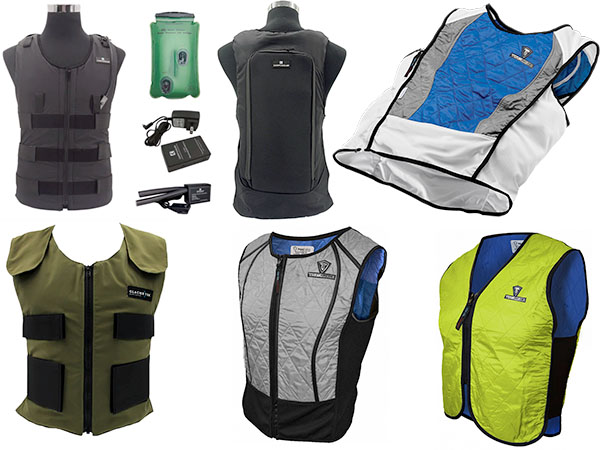
Summers are getting hotter, so there’s a good chance you’ll be training and racing in very hot weather. Don’t let intense heat prevent you from getting a ride or workout in – stay cool in the summer heat with a cooling vest.
You may see pro cyclists wearing cooling vests before – or even during – certain races. Pay close attention to riders warming up for the TT stages of the Tour de France. It’s hot in July and these vests help racers keep their core temps low until it’s race time.
You can buy the same thing the pros are using. To choose the best cooling vest for your needs, I have compiled this helpful list.
The Best Cooling Vests
These are the best cooling vests for endurance athletes. Check out our top pick if you need the best, most versatile option ($200), or check out our budget pick for a quality vest at a low price ($50).
Best Overall: TechNiche Hybrid Sport Cooling Vest (HyperKewl + Cool Pax)

For most cyclists who want one do-it-all cooling vest, I’ve found the TechNiche Hybrid Sport Cooling Vest to be the best choice. This vest uses a hybrid cooling system utilizing both TechKewl (Cool Pax phase change inserts) and HyperKewl (evaporative material) technologies.
The hybrid approach keeps this vest relatively lightweight, but much more effective and versatile than a simple evaporative cooling vest. It will provide cooling relief regardless of your activity. It’s effective on bike rides and runs, stationary trainer warmups, indoor workouts, and more.
And you can tell just by looking at it that it is designed for athletes! It looks similar to a sleeveless cycling jersey.
The price tends to range from $180-220 depending on where you shop. It’s worth it.
Buy online: Compare prices at Amazon.com and Walmart.com
Expand for more details
Budget Pick: HyperKewl Cooling Sport Vest

The HyperKewl Cooling Sport Vest from TechNiche International is the cheaper version of our top pick. This is a lightweight vest with a simple design, and the simplicity means it’s rather comfortable, too.
The big difference is that this vest only uses HyperKewl technology, which is the basic evaporative cooling method. It does NOT use phase-change packs.
As such, this vest works best when you are moving. So it works well for riding and running outdoors. If that is what you plan to do, this is a great investment!
(If you’re on a stationary trainer, you might not generate enough airflow to get much cooling effect.)
Best of all, the vest sells for under $50, so it’s great if you’re on a limited budget!
Buy online: Compare prices at Amazon.com and Walmart.com
Expand for more details
Best Value: Polar Products Adjustable Cooling Pack Vest

While most phase change vests are priced around $200 or more, this cooling pack vest from Polar Products starts at $136. It’s not advanced like our top pick, but it works.
It’s a basic nylon vest with lots of Velcro adjustments, so you can get a proper fit, and it comes with Kool Max frozen water-based packs. So you freeze the packs in advance, then put them in the vest, and then put the vest on; as the packs melt, you get cooling relief.
Personally, I’d still pay a little more for the top pick that’s a sportier design, but this one works.
Buy online: Check price at PolarProducts.com
Expand for more details
Best Color Selection: GlacierTek Sports Vest

The GlacierTek Sports Vest is a phase change vest utilizing special PureTemp gel packs for cooling (rather than simple water-based packs). It’s made in the USA and features high-quality construction – you can just tell it looks durable. All that for $199.
But what really sets this one apart is the color selection!
Our top picks for cooling vests usually come in black or silver, maybe blue if you’re lucky. This one comes in gray, tan, red, blue, or olive green.
It has a tactical look to it as well, so bystanders will recognize that you aren’t messing around!
Buy online: Compare prices at Amazon.com and MyCoolingStore.com
Expand for more details
Best For Pre-Race Warm-ups: COMPCOOLER UniVest ICE Water Cooling System

The COMPCOOLER is a water circulation vest. It literally circulates cool water in tubing around your body to keep you cool.
It’s high-tech, but it’s also a bit heavy, with the water reservoir and battery pack!
As such, it’s best for pre-race warm-ups and post-ride recovery. I wouldn’t want to use it while riding or running. But it’s a great choice if you need it before and after your workouts. This is the sort of thing you see Tour de France riders wearing on the stationary trainer when they’re warming up before a time trial stage!
Their most popular model is priced at $229.
Buy online: Compare prices at Amazon.com and MyCoolingStore.com
Expand for more details
There is no shortage of cooling vests on the market. But there aren’t that many that are well-made, worth the money, and sensible for endurance athletes.
In case you’re curious, here’s a list of other vests I’ve had to sort through that I would not recommend:
NOT recommended for endurance athletes
How to Choose a Cooling Vest
Choosing the right cooling vest can be quite a challenge. Endurance athletes have different needs compared to golfers and race car drivers, so just because a particular vest is highly-rated and very popular does not mean it will meet your needs.
Here are my criteria for ranking the best cooling vests for endurance athletes like runners and cyclists, which you can also use when choosing the best cooling vest for yourself.
Cooling effectiveness
“Will this vest keep me cool enough, for long enough?”
The entire point of the vest is to keep you cool. So at a minimum, it needs to keep you cool!
Not all vests will keep you cool in all situations. Some vests require airflow to work, which means they would not work if you’re on a stationary trainer or treadmill, or if you’re wearing it beneath an outer layer.
The other aspect is how long the cooling effect lasts. If you need cooling for 2+ hours at a time, you’ll need a more expensive vest.
If a vest will not keep you cool enough, for long enough, then nothing else matters.
Ease of use
“Is this practical for my situation?”
A cooling vest needs to be easy enough to use that you’re actually willing to use it.
All these vests require some effort, but it varies considerably.
For instance, some vests need to be soaked in water, and some others require you to freeze ice packs in advance. There are situations where you might not have access to a freezer, potentially rendering your cooling vest useless.
You wouldn’t want to delay your bike ride waiting for your vest to be ready. And you certainly wouldn’t want to miss the race start due to hassling with a cooling vest.
You’re going to find a lot of cooling vests made for firefighters and race car drivers – people that are working in harsh environments, but not necessarily exercising like an endurance athlete would. You have to weed those out because they’re not really practical for your use case.
Proper fit
“Will this fit me correctly and stay in place?”
Getting the right fit is super important because you want to be able to move freely but the vest needs to stay in one place.
First, you want a tight fit so the vest is not flopping around, catching the wind and slowing you down, etc. Second, it needs to be snug against your body to get the cooling effect. If there is a gap, the cool material and/or ice pack aren’t going to cool you down.
So you want one where the combination of size and available adjustments gets you the right fit. Some vests come in multiple sizes while others are very adjustable. There is no wrong way of doing it, as long as the end result is a properly-fitting vest.
If the vest simply pulls on, it might be more comfortable, but it means it’s critical that you buy the right size.
Vests that use straps and buckles might not look as comfortable, but because they allow for a custom fit, they could prove to be the most comfortable in the end.
Comfort
“Is this comfortable enough that I’ll actually wear it?”
While comfort is not the top priority, it’s not something to ignore. The vest has to be comfortable enough that it’s worth wearing.
You can get away with a slightly uncomfortable vest because you’ll likely forget about it once you’re pedaling hard!
But if it’s truly uncomfortable, it’s going to interfere with your workout. It would be better to seek an alternative workout than to wear an uncomfortable cooling vest.
The most crucial aspect here is that it should not restrict your range of motion. You should still be able to twist and rotate and swing your arms without issue.
You probably won’t have issues with bicycling, but any movement restrictions can impact your running, and it would be quite a problem if you’re using it for paddling.
In general, pay attention to the fabric type, weight, and arm openings.
Durability
“Am I going to get my money’s worth?”
Almost all cooling vests cost more than $100, and quite a few are close to or more than $200. So you expect a high-quality product.
You want the vest to be built well so that it lasts.
I’m sure we’ve all dealt with leaky ice packs in our lunch boxes before. You definitely don’t want that to happen here!
Perhaps you’ve had a broken zipper on a $20 wind vest. Eh, that’s mildly irritating. But a broken zipper on a $200 cooling vest, now that’s a serious problem!
I want a good warranty and/or easy-to-find replacement parts so I can repair it myself or take it to a local shop and have it repaired for a small fee.
Is a Cooling Vest Worth It?
Aside from the $50 budget pick, a lot of these vests cost $200 or more.
They cost more than some nice rain jackets and helmets do!
Is it worth it?
Well, to find out, we first need to understand how cooling vests work and why you might want one.
How does a cooling vest work?
The idea is to keep you cool. But how?
Well, it depends on the vest. There are three styles:
- Evaporative
- Phase change
- Water circulation
Each works differently. Here’s an explainer:
Evaporative cooling vests use the natural process of evaporation to cool you down. Before your workout, you submerge the vest in water. The special fabric or embedded cooling crystals absorb lots of water. While you’re wearing the vest, the water slowly evaporates. This pulls heat away from your body and releases it into the air.
These vests are thin, lightweight, and affordable. And they are the easiest to ‘recharge’ when electricity is not available.
Certainly less messy than dousing yourself with your water bottle every 15 minutes!
The downside is that these vests don’t work well when you’re stationary or when there is high humidity.
Phase change cooling vests use ice packs to keep you cool. You put the ice packs in the freezer, and once frozen, they go into strategically-placed pockets on the vest. As the ice packs “phase change” from frozen solid to liquid, they cool your body.
This style vest has a more pronounced cooling effect than an evaporative vest, so it keeps you colder. These vests work regardless of humidity and regardless of external airflow. So they work fine whether you’re out biking or just on your trainer.
The downside is that the cooling doesn’t last as long. And it takes longer to recharge between uses as the ice packs must be frozen again.
It’s not a particularly smart choice for endurance athletes unless you have a team car following you with spare ice packs in a cooler for you to swap in!
These vests generally start in the $200 range and go up from there. If you want to get really fancy, you can get phase change gel packs that are a big upgrade compared to regular ice packs. These contain a special phase-changing material rather than ice, and this stuff is made to freeze at 58 degrees F. So it’s easier to “freeze” it compared to water which needs to get down to 32 degrees F.
*There is also a hybrid style combining evaporative and phase change technologies into one vest. That’s my top pick for endurance athletes.
Water circulation vests work by circulating cool water through tubing around the wearer’s body. A circulatory vest will keep you cool in most any situation, so long as you don’t mind carrying a water reservoir and battery pack along!
This idea is based on technology developed by NASA, so you know it works. But these vests are very bulky and very expensive. They start around $250 but don’t be surprised to see one for $400.
These are not really an option for athletes other than wearing it on the stationary trainer during a pre-race warmup or using it for off-bike recovery or cold therapy.
Why use a cooling vest?
First of all, it’s just plain uncomfortable to be too hot. But more importantly, your performance decreases if you are too hot!
As your core temperature increases past a certain point, your performance decreases. Multiple studies have shown this.
For example, a study published in the Journal of Applied Physiology found that a 1-degree increase in core body temperature resulted in a 1-2% decrease in running performance. Another study, published in the Journal of Science and Medicine in Sport, found that a 1-degree increase in core body temperature resulted in a 1-3% decrease in cycling performance.
If you’re racing – or training for a race – that’s a big deal.
So wearing a cooling vest is not entirely about keeping you feeling cool. It’s more about keeping your core temperature within the normal range, preventing the overheating that’s going to lead to decreased performance.
It could also help prevent heat-related illnesses. Think of it like extra insurance on top of your body’s existing regulatory system.
When is it best to wear a cooling vest?
There are three great ways for endurance athletes to utilize a cooling vest:
- During training and racing
- During your pre-race warmup
- For cold therapy
If you’re training in the heat, wearing a cooling vest during your rides will help keep you cool, which helps you accomplish a more effective workout. If you are competing in an event where it’s so hot that it’s dangerous, you might even wear a cooling vest during the event. Typically you wouldn’t want that extra weight penalty, but in certain circumstances, it could be a worthwhile trade-off.
For shorter events where your pre-race warm-up is relatively long and intense, you can realize great benefits by wearing a cooling vest while you’re riding the trainer. This is especially common for time trials. Pay attention to the Tour de France coverage on the ITT stage – if it’s a hot day in July, many riders can be seen wearing cooling vests during their warm-ups.
You can also use a cooling vest for a form of cold therapy. It’s simpler and less scary than plunging into an ice bath!
Would a cooling vest double as a weighted vest?
No. Compared to a weighted vest, a cooling vest is negligible. These vests are at most 4-5 pounds. Compare that to 20-40 pounds for a real weighted vest!
So this wouldn’t really take the place of a weighted vest. (Not that I recommend wearing a weighted vest while cycling.)
Do I wear this vest under my jersey or over my jersey?
You’ll want your vest close to your skin, but also exposed to airflow. Given that cycling jerseys are made of wicking material and tend to be very form-fitting, it’s fine to wear the cooling vest on top of your jersey.
If you wanted to hide it, you might get away with wearing it over top of an undershirt base layer, but beneath a cycling jersey.
Where you’d get into trouble is if you wore it beneath a rain jacket. That would decrease the airflow and thus the evaporative cooling effect.
Can you wear both a cooling vest and a hydration pack?
Yes, you can wear a hydration pack over top of a cooling vest. But depending on the type of vest, it might not be super comfortable.
It could also be pretty heavy.
Can you make a DIY cooling vest?
Yes, you can make your own cooling vest alternative. It’s quick and cheap. All you need are ice cubes and pantyhose!
This is something I’ve seen Allen Lim do with the Garmin Slipstream team. He stuffs ice cubes into cut lengths of women’s panty hose and instructs riders to drape them around their necks or stuff them down their backs during stages.
How else can I stay cool?
In addition to wearing a cooling vest, consider covering up exposed skin by wearing arm cooling sleeves. (Basically the opposite of arm warmers.)
And don’t forget that wearing sunscreen can help keep you cool! It prevents your skin from absorbing heat from the sun. (Just make sure you get one that’s water-resistan or sweat-resistant.)
If that’s not enough, you’re better off indoors. (Here are the best indoor trainers that allow to keep riding even if you can’t leave the house.)
*Seriously, only ride outside if it’s safe. If you’re at risk of heat exhaustion, or you have forest fires nearby, stay inside and ride the trainer.
Show References
Levi Bloom is an experienced endurance athlete who has been training and competing for over 17 years. A former Cat 1 road and mountain bike racer (professional class on the regional circuit), he is now a cycling coach (USA Cycling Level 3 Certified) and sports nutrition coach (Precision Nutrition Level 1 Certified).



Want to echo your remarks on safety. I’m hearing about more DNFs this year with people are abandoning races early due to heat. Like the local Rothrock Grit gravel race. Perfect example. Some people skipped the race entirely this year due to the heat wave. This cooling vest is a good idea, but also, be smart!
@Joshua
I was there and was glad I wasn’t racing. It’s tough when you get crazy heat waves early in the year before you’ve had a chance to acclimate.
i’m surprised you didn’t include the flexifreeze vest here. i constantly hear how great it is.
@Danny
Interesting you say that, because I’ve also seen good reviews and top rankings for the Flexifreeze vest. Yet, it does not look like something that would be good for a cyclist. Upon further research, I found the manufacturer’s website makes no claims that it is good for athletes. Instead, they say it’s good for gardening and mowing the lawn. That’s why I included this one in the “not recommended” section.
This example also shows you that many websites don’t do their research and likely have never tested the products they write about!